

SUN HYDRAULICS
CBDHLCN
$118.44 USD
- SUN HYDRAULICS
- Material:CBDHLCN
- Model:CBDH-LCN
- Summary:Cartridge
Quantity in stock: 0
***Disclaimer: The following summary contains information gathered from various sources such as product descriptions, technical specifications and catalogs. While efforts have been made to provide accurate details, inaccuracies may occur. It is advised to verify all information by contacting Sun Hydraulics directly.***
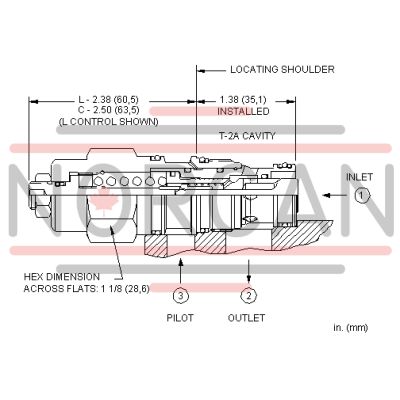
The Sun Hydraulics CBDHLCN (CBDHLCN) is a counterbalance valve designed for controlling overrunning loads in hydraulic systems. It features a check valve that permits free flow from the directional valve port 2 to the load port 1, while a direct-acting, pilot-assisted relief valve manages flow from port 1 to port 2. The pilot assist at port 3 reduces the effective setting of the relief valve based on the pilot ratio. This model is suitable for applications where precise motion control is critical, such as in mobile hydraulics and heavy machinery. The CBDHLCN has a capacity of up to 5 gpm (20 L/min) and can handle maximum load pressures up to 3850 psi (270 bar), with an absolute maximum setting of 5000 psi (350 bar). It features adjustable settings, with an adjustment number of 3.75 counterclockwise turns to increase pressure settings. The valve is engineered with Sun’s floating style construction, which minimizes internal parts binding due to installation torque or cavity/cartridge machining variations, enhancing reliability and performance longevity. This model also offers versatility in installation options; it can be directly installed into cavities machined into actuator housings. This not only protects the cartridge but also improves stiffness within the circuit. Sun Hydraulics ensures high-quality seals between all ports and offers two check valve cracking pressures to cater to different application needs regarding actuator cavitation concerns. Overall, the Sun Hydraulics CBDHLCN counterbalance valve is engineered for robust performance in demanding applications, ensuring stability and control in hydraulic circuits handling overrunning loads.
The Sun Hydraulics CBDHLCN (CBDHLCN) is a counterbalance valve designed for controlling overrunning loads in hydraulic systems. It features a check valve that permits free flow from the directional valve port 2 to the load port 1, while a direct-acting, pilot-assisted relief valve manages flow from port 1 to port 2. The pilot assist at port 3 reduces the effective setting of the relief valve based on the pilot ratio. This model is suitable for applications where precise motion control is critical, such as in mobile hydraulics and heavy machinery. The CBDHLCN has a capacity of up to 5 gpm (20 L/min) and can handle maximum load pressures up to 3850 psi (270 bar), with an absolute maximum setting of 5000 psi (350 bar). It features adjustable settings, with an adjustment number of 3.75 counterclockwise turns to increase pressure settings. The valve is engineered with Sun’s floating style construction, which minimizes internal parts binding due to installation torque or cavity/cartridge machining variations, enhancing reliability and performance longevity. This model also offers versatility in installation options; it can be directly installed into cavities machined into actuator housings. This not only protects the cartridge but also improves stiffness within the circuit. Sun Hydraulics ensures high-quality seals between all ports and offers two check valve cracking pressures to cater to different application needs regarding actuator cavitation concerns. Overall, the Sun Hydraulics CBDHLCN counterbalance valve is engineered for robust performance in demanding applications, ensuring stability and control in hydraulic circuits handling overrunning loads.
Counterbalance valves with pilot assist are meant to control an overrunning load. The check valve allows free flow from the directional valve (port 2) to the load (port 1) while a direct-acting, pilot-assisted relief valve controls flow from port 1 to port 2. Pilot assist at port 3 lowers the effective setting of the relief valve at a rate determined by the pilot ratio.
Other names for this valve include motion control valve and over center valve.
- Counterbalance valves should be set at least 1.3 times the maximum load induced pressure.
- Restrictive valves have no relief capacity other than as a thermal relief.
- Full clockwise setting is less than 200 psi (14 bar).
- Backpressure at port 2 adds to the effective relief setting at a ratio of 1 plus the pilot ratio times the backpressure.
- Reseat exceeds 85% of set pressure when the valve is standard set. Settings lower than the standard set pressure may result in lower reseat percentages.
- Sun counterbalance cartridges can be installed directly into a cavity machined in an actuator housing for added protection and improved stiffness in the circuit.
- Two check valve cracking pressures are available. Use the 25 psi (1,7 bar) check unless actuator cavitation is a concern.
- This valve has positive seals between all ports.
- All 3-port counterbalance, load control, and pilot-to-open check cartridges are physically interchangeable (i.e. same flow path, same cavity for a given frame size).
- Incorporates the Sun floating style construction to minimize the possibility of internal parts binding due to excessive installation torque and/or cavity/cartridge machining variations.
| Cavity | T-2A |
| Series | 2 |
| Capacity | 5 gpm20 L/min. |
| Maximum Recommended Load Pressure at Maximum Setting | 3850 psi270 bar |
| Maximum Setting | 5000 psi350 bar |
| Factory Pressure Settings Established at | 2 in³/min.30 cc/min. |
| Adjustment - Number of Counterclockwise Turns to Increase Setting | 3.753.75 |
| Operating Characteristic | RestrictiveRestrictive |
| Valve Hex Size | 1 1/8 in.28,6 mm |
| Valve Installation Torque | 45 - 50 lbf ft61 - 68 Nm |
| Adjustment Screw Internal Hex Size | 5/32 in.4 mm |
| Locknut Hex Size | 9/16 in.15 mm |
| Locknut Torque | 80 - 90 lbf in.9 - 10 Nm |
| Model Weight | .60 lb0,30 kg |
| Seal kit - Cartridge | Viton: 990-202-006 |
Show FAQ