

SUN HYDRAULICS
COHAEDN
$142.77 USD
- SUN HYDRAULICS
- Material:COHAEDN
- Model:COHA-EDN
- Summary:Cartridge
Quantity in stock: 0
***Disclaimer: The following summary contains information gathered from various sources such as product descriptions, technical specifications and catalogs. While efforts have been made to provide accurate details, inaccuracies may occur. It is advised to verify all information by contacting Sun Hydraulics directly.***
The Sun Hydraulics COHAEDN (COHAEDN) is a spring-biased, pilot-to-close check cartridge valve designed to facilitate controlled hydraulic operations. The valve features a nominal pilot ratio of 1.8:1, allowing for efficient management of flow from port 1 to port 2 while blocking reverse flow under any condition. It operates by opposing the pressure at the pilot port against the pressure at port 1 with its specified pilot ratio, meaning that a pressure of 1000 psi at the pilot can close against a pressure of 1800 psi at port 1. This model is specifically engineered for use in regeneration circuits where reliable performance and durability are critical. The COHAEDN valve incorporates Sun\u2019s floating style construction which helps minimize internal parts binding due to excessive installation torque or variations in cavity/cartridge machining, ensuring consistent operation and longevity. The valve has a maximum operating pressure capacity of 5000 psi and can handle up to 80 gpm (320 L/min), making it suitable for high-pressure applications. It also features minimal leakage specifications, with maximum valve leakage noted at approximately 1 drop per minute. For installation, the valve requires a hex size of 1-1/4 inches and an installation torque between 150 -160 lbf ft. Additionally, the COHAEDN model has been updated to include positive seals on the pilot pistons which were previously only available on certain models, now providing enhanced sealing capabilities across all units. This model also comes with Viton seals as part of its cartridge kit, ensuring compatibility and performance in various hydraulic systems.
The Sun Hydraulics COHAEDN (COHAEDN) is a spring-biased, pilot-to-close check cartridge valve designed to facilitate controlled hydraulic operations. The valve features a nominal pilot ratio of 1.8:1, allowing for efficient management of flow from port 1 to port 2 while blocking reverse flow under any condition. It operates by opposing the pressure at the pilot port against the pressure at port 1 with its specified pilot ratio, meaning that a pressure of 1000 psi at the pilot can close against a pressure of 1800 psi at port 1. This model is specifically engineered for use in regeneration circuits where reliable performance and durability are critical. The COHAEDN valve incorporates Sun\u2019s floating style construction which helps minimize internal parts binding due to excessive installation torque or variations in cavity/cartridge machining, ensuring consistent operation and longevity. The valve has a maximum operating pressure capacity of 5000 psi and can handle up to 80 gpm (320 L/min), making it suitable for high-pressure applications. It also features minimal leakage specifications, with maximum valve leakage noted at approximately 1 drop per minute. For installation, the valve requires a hex size of 1-1/4 inches and an installation torque between 150 -160 lbf ft. Additionally, the COHAEDN model has been updated to include positive seals on the pilot pistons which were previously only available on certain models, now providing enhanced sealing capabilities across all units. This model also comes with Viton seals as part of its cartridge kit, ensuring compatibility and performance in various hydraulic systems.
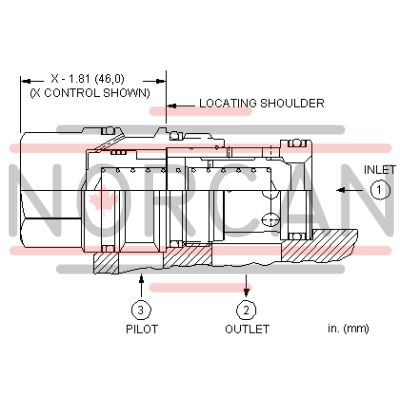
This valve is a spring biased closed, pilot-to-close check cartridge that has a 1.8:1 pilot ratio. The valve allows flow from port 1 to port 2 and blocks reverse flow. Pressure at the pilot port opposes pressure at port 1 at a ratio of 1.8:1. This valve is most often used in regeneration circuits.
- Nominal pilot ratio is 1.8:1. This means that a pressure of 1000 psi (70 bar) at the pilot port will close a valve against a pressure of 1800 psi (125 bar) at port 1. Any decay or loss of pilot pressure could allow the valve to open, even if it is a momentary decay or loss.
- Pressure at the port 2 area directly opposes pilot pressure.
- Reverse flow through the valve from port 2 to port 1 is not possible under any condition.
- With equal pressures at all ports the valve is closed.
- In the begining the CO*A's did not have a positive seal on the pilot pistons and the CO*B's did. Now the CO*A's are positively sealed and the 2 valves are mechanically identical. CO*A's are more readily available and cost less.
- Corrosion resistant cartridge valves are intended for use in corrosive environments and are identified by the model code suffix /AP or /LH (see CONFIGURATION section). For further details, please see the Materials of Construction page under TECHNICAL RESOURCES.
- Incorporates the Sun floating style construction to minimize the possibility of internal parts binding due to excessive installation torque and/or cavity/cartridge machining variations.
| Cavity | T-17A |
| Series | 3 |
| Capacity | 80 gpm320 L/min. |
| Pilot Ratio | 1.8:11.8:1 |
| Maximum Operating Pressure | 5000 psi350 bar |
| Maximum Valve Leakage at 110 SUS (24 cSt) | 1 drops/min.0,07 cc/min. |
| Valve Hex Size | 1 1/4 in.31,8 mm |
| Valve Installation Torque | 150 - 160 lbf ft203 - 217 Nm |
| Model Weight | 1.80 lb0,80 kg |
| Seal kit - Cartridge | Viton: 990-017-006 |
Show FAQ