

SUN HYDRAULICS
DODPKBN
$145.45 USD
- SUN HYDRAULICS
- Material:DODPKBN
- Model:DODP-KBN
- Summary:Cartridge
Quantity in stock: 0
***Disclaimer: The following summary contains information gathered from various sources such as product descriptions, technical specifications and catalogs. While efforts have been made to provide accurate details, inaccuracies may occur. It is advised to verify all information by contacting Sun Hydraulics directly.***
The Sun Hydraulics DODPKBN (DODPKBN) is a normally open, balanced poppet switching element designed for precise hydraulic applications. This component functions by maintaining an open position until pilot pressure at port 3 reaches a predetermined level set by the integral pilot relief stage, subsequently shifting to a closed position. Its unique balanced construction ensures predictable switching under high-pressure conditions, supporting up to 5000 psi (350 bar) at both port 1 and port 2. The valve is engineered to open when pilot pressure drops below 145 psi (10 bar), providing reliable performance in various hydraulic systems. The DODPKBN features low leakage rates between ports 1 and 2, typically less than 10 drops per minute at maximum pressure, ensuring efficient operation with minimal fluid loss. It incorporates Sun's floating style construction, reducing the risk of internal parts binding due to excessive installation torque or machining variations. All ports can handle pressures up to 5000 psi (350 bar), with ports 1 and 2 fully sealed from ports 3 and 4, which are also positively sealed. The valve is designed for installation in T21A cavities and belongs to Series 1 with a capacity of handling flow rates up to 15 gpm (60 L/min). The minimum pilot pressure required to shift the valve is 400 psi (28 bar). Additional specifications include a valve hex size of 7/8 inches (22.2 mm), an installation torque range of 30-35 lbf ft (41-47 Nm), and an adjustment screw internal hex size of 5/32 inches (4 mm). The locknut has a hex size of 9/16 inches (15 mm) with a torque requirement of between 80-90 lbf in (9-10 Nm). The cartridge seal kit is available in Viton material under part number: 990021006.
The Sun Hydraulics DODPKBN (DODPKBN) is a normally open, balanced poppet switching element designed for precise hydraulic applications. This component functions by maintaining an open position until pilot pressure at port 3 reaches a predetermined level set by the integral pilot relief stage, subsequently shifting to a closed position. Its unique balanced construction ensures predictable switching under high-pressure conditions, supporting up to 5000 psi (350 bar) at both port 1 and port 2. The valve is engineered to open when pilot pressure drops below 145 psi (10 bar), providing reliable performance in various hydraulic systems. The DODPKBN features low leakage rates between ports 1 and 2, typically less than 10 drops per minute at maximum pressure, ensuring efficient operation with minimal fluid loss. It incorporates Sun's floating style construction, reducing the risk of internal parts binding due to excessive installation torque or machining variations. All ports can handle pressures up to 5000 psi (350 bar), with ports 1 and 2 fully sealed from ports 3 and 4, which are also positively sealed. The valve is designed for installation in T21A cavities and belongs to Series 1 with a capacity of handling flow rates up to 15 gpm (60 L/min). The minimum pilot pressure required to shift the valve is 400 psi (28 bar). Additional specifications include a valve hex size of 7/8 inches (22.2 mm), an installation torque range of 30-35 lbf ft (41-47 Nm), and an adjustment screw internal hex size of 5/32 inches (4 mm). The locknut has a hex size of 9/16 inches (15 mm) with a torque requirement of between 80-90 lbf in (9-10 Nm). The cartridge seal kit is available in Viton material under part number: 990021006.
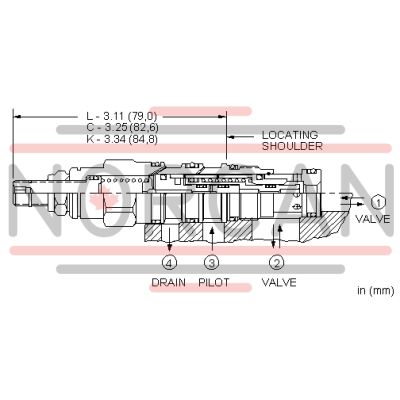
This is a normally open, balanced poppet, switching element. When pilot pressure is applied to port 3, the poppet remains open until the pilot pressure reaches the setting established by the integral pilot relief stage, at which point the poppet shifts to the closed position.
- Unique balanced construction provides predictable switching with 5000 psi (350 bar) at both port 1 and port 2. When the remote pressure signal at port 3 exceeds the internal valve setting, the valve shifts to the closed position.
- Any backpressure at the drain port is directly additive to the valve setting.
- Valve will open when the pilot pressure falls below 145 psi (10 bar).
- These valves are hydraulically balanced between port 1 and port 2.
- Port 1 and port 2 are fully sealed from port 3 and port 4. Ports 3 and 4 are positively sealed.
- Leakage rate between port 1 and port 2 is very low, typically less than 10 drops/min. at 5000 psi (0,7 cc/min at 350 bar).
- All ports will accept 5000 psi (350 bar).
- Incorporates the Sun floating style construction to minimize the possibility of internal parts binding due to excessive installation torque and/or cavity/cartridge machining variations.
| Cavity | T-21A |
| Series | 1 |
| Capacity | 15 gpm60 L/min. |
| Minimum Pilot Pressure Required to Shift Valve | 400 psi28 bar |
| Maximum Operating Pressure | 5000 psi350 bar |
| Control Pilot Flow | See Performance DataSee Performance Data |
| Maximum Valve Leakage at 110 SUS (24 cSt) | 10 drops/min.@5000 psi0,7 cc/min.@350 bar |
| Valve Hex Size | 7/8 in.22,2 mm |
| Valve Installation Torque | 30 - 35 lbf ft41 - 47 Nm |
| Adjustment Screw Internal Hex Size | 5/32 in.4 mm |
| Locknut Hex Size | 9/16 in.15 mm |
| Locknut Torque | 80 - 90 lbf in.9 - 10 Nm |
| Seal kit - Cartridge | Viton: 990-021-006 |
Show FAQ