

SUN HYDRAULICS
DPCCCAN
$143.96 USD
- SUN HYDRAULICS
- Material:DPCCCAN
- Model:DPCC-CAN
- Summary:Cartridge
Quantity in stock: 0
***Disclaimer: The following summary contains information gathered from various sources such as product descriptions, technical specifications and catalogs. While efforts have been made to provide accurate details, inaccuracies may occur. It is advised to verify all information by contacting Sun Hydraulics directly.***
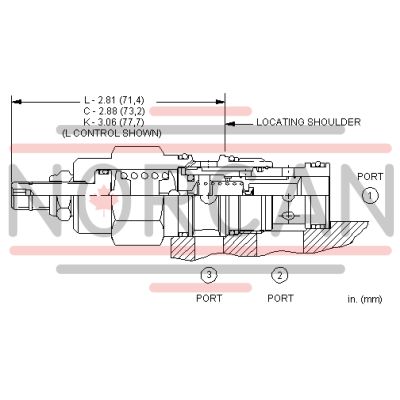
The Sun Hydraulics DPCCCAN (Material Number: DPCCCAN) is a pilot-operated, 3-way directional cartridge valve designed for moderate flow circuits. It is versatile in its application, able to function independently or in conjunction with larger pilot-operated or logic cartridges. The valve operates by shifting when the pressure differential between port 1 and port 3 surpasses a specified setting, with pressure at port 3 being directly additive to the valve setting. This feature necessitates careful consideration of port usage, as port 3 might not be suitable as a work port unless opting for the four-port version of this valve. The DPCCCAN is not bistable; it modulates between two positions and can be blocked at port 3 to prevent shifting. This cartridge incorporates Sun's floating style construction, which minimizes internal part binding caused by excessive installation torque or machining variations. It fits T2A cavities and belongs to Series 2, with a capacity of up to 15 gpm (60 L/min). The maximum operating pressure is rated at 5000 psi (350 bar), while the maximum pressure at port 3 should be limited to 3000 psi (210 bar) due to fatigue strength limits. The valve features an adjustment range for increasing settings via clockwise turns and includes specifications for installation torque and hex sizes for both the valve and locknut. For applications requiring precise control over pilot flow versus load pressure, performance curves are available. If pilot flow becomes an issue when exceeding valve settings, a direct-acting version may be more suitable. With factory pressure settings established at 4 gpm (15 L/min) and minimal leakage rates, this model offers reliability and efficiency in hydraulic systems requiring directional control capabilities.
The Sun Hydraulics DPCCCAN (Material Number: DPCCCAN) is a pilot-operated, 3-way directional cartridge valve designed for moderate flow circuits. It is versatile in its application, able to function independently or in conjunction with larger pilot-operated or logic cartridges. The valve operates by shifting when the pressure differential between port 1 and port 3 surpasses a specified setting, with pressure at port 3 being directly additive to the valve setting. This feature necessitates careful consideration of port usage, as port 3 might not be suitable as a work port unless opting for the four-port version of this valve. The DPCCCAN is not bistable; it modulates between two positions and can be blocked at port 3 to prevent shifting. This cartridge incorporates Sun's floating style construction, which minimizes internal part binding caused by excessive installation torque or machining variations. It fits T2A cavities and belongs to Series 2, with a capacity of up to 15 gpm (60 L/min). The maximum operating pressure is rated at 5000 psi (350 bar), while the maximum pressure at port 3 should be limited to 3000 psi (210 bar) due to fatigue strength limits. The valve features an adjustment range for increasing settings via clockwise turns and includes specifications for installation torque and hex sizes for both the valve and locknut. For applications requiring precise control over pilot flow versus load pressure, performance curves are available. If pilot flow becomes an issue when exceeding valve settings, a direct-acting version may be more suitable. With factory pressure settings established at 4 gpm (15 L/min) and minimal leakage rates, this model offers reliability and efficiency in hydraulic systems requiring directional control capabilities.
Pilot-operated, 3-way directional cartridges (1 blocked, 2 to 3 open) are switching devices typically used in moderate flow circuits. They can be used by themselves or to actuate larger pilot-operated directional cartridges or logic cartridges. The valve shifts when the pressure differential between port 1 and port 3 exceeds the setting.
- Pressure at port 3 is directly additive to the setting of the valve. Because of this, port 3 may not be useable as a work port in your circuit. If this is a consideration, the 4 port version of this valve may be a solution.
- Direct-acting and pilot-operated versions of these valves are interchangeable. They fit the same cavities and have the same flow paths.
- Port 3 can be blocked to prevent the valve from shifting.
- This valve is not bistable; it is capable of modulating between the two positions shown.
- Maximum pressure at port 3 should be limited to 3000 psi (210 bar). This is due to fatigue strength limits not hydraulic operating limits.
- When pilot pressure exceeds the valve setting, pilot flow may be a consideration. See performance curves for pilot consumption vs. load pressure above the valve setting. If this is a problem, the direct acting version of this valve would be a solution.
- Incorporates the Sun floating style construction to minimize the possibility of internal parts binding due to excessive installation torque and/or cavity/cartridge machining variations.
| Cavity | T-2A |
| Series | 2 |
| Capacity | 15 gpm60 L/min. |
| Factory Pressure Settings Established at | 4 gpm15 L/min. |
| Maximum Operating Pressure | 5000 psi350 bar |
| Control Pilot Flow | 10 - 15 in³/min.0,16 - 0,25 L/min. |
| Maximum Valve Leakage at 110 SUS (24 cSt) | 1 in³/min.@1000 psi15 cc/min.@70 bar |
| Adjustment - Number of Clockwise Turns to Increase Setting | 55 |
| Valve Hex Size | 1 1/8 in.28,6 mm |
| Valve Installation Torque | 45 - 50 lbf ft61 - 68 Nm |
| Adjustment Screw Internal Hex Size | 5/32 in.4 mm |
| Locknut Hex Size | 9/16 in.15 mm |
| Locknut Torque | 80 - 90 lbf in.9 - 10 Nm |
| Model Weight | .60 lb0,30 kg |
| Seal kit - Cartridge | Viton: 990-202-006 |
Show FAQ