

SUN HYDRAULICS
PBFBQQN
$110.30 USD
- SUN HYDRAULICS
- Material:PBFBQQN
- Model:PBFB-QQN
- Summary:Cartridge
Quantity in stock: 0
***Disclaimer: The following summary contains information gathered from various sources such as product descriptions, technical specifications and catalogs. While efforts have been made to provide accurate details, inaccuracies may occur. It is advised to verify all information by contacting Sun Hydraulics directly.***
The Sun Hydraulics PBFBQQN (Material Number: PBFBQQN) is a pilot-operated pressure reducing valve designed to manage high primary pressures by reducing them to a constant lower pressure. This valve is ideal for circuits requiring multiple pressure levels, as it allows these variations to be managed with a single pump. The PBFBQQN model is interchangeable with other three-port pressure reducing and relieving cartridges of the same frame size, offering flexibility in circuit design. It features a robust construction that includes a 150-micron stainless steel screen protecting the main stage orifice, ensuring reliability and durability under various operating conditions. The recommended maximum inlet pressure varies according to the adjustment range, with capabilities up to 5000 psi (350 bar) for certain ranges. The valve exhibits stable performance with low hysteresis and flat pressure-flow characteristics, making it suitable for applications where consistent output is critical. However, users should note that pilot-operated valves like this one are not as fast-acting as direct-acting valves, which may be preferable in applications demanding superior dynamic response. The PBFBQQN model incorporates Sun's floating style construction to minimize internal binding risks due to installation torque or machining variations. Additional features include an adjustable setting through W or Y controls, which can be specified with or without a special setting for maximum versatility. With its capacity of 20 gpm (80 L/min), the valve ensures efficient flow management in hydraulic systems. The cartridge can also be configured with EPDM seals for use in systems utilizing phosphate ester fluids, although exposure to petroleum-based substances should be avoided to prevent seal damage.
The Sun Hydraulics PBFBQQN (Material Number: PBFBQQN) is a pilot-operated pressure reducing valve designed to manage high primary pressures by reducing them to a constant lower pressure. This valve is ideal for circuits requiring multiple pressure levels, as it allows these variations to be managed with a single pump. The PBFBQQN model is interchangeable with other three-port pressure reducing and relieving cartridges of the same frame size, offering flexibility in circuit design. It features a robust construction that includes a 150-micron stainless steel screen protecting the main stage orifice, ensuring reliability and durability under various operating conditions. The recommended maximum inlet pressure varies according to the adjustment range, with capabilities up to 5000 psi (350 bar) for certain ranges. The valve exhibits stable performance with low hysteresis and flat pressure-flow characteristics, making it suitable for applications where consistent output is critical. However, users should note that pilot-operated valves like this one are not as fast-acting as direct-acting valves, which may be preferable in applications demanding superior dynamic response. The PBFBQQN model incorporates Sun's floating style construction to minimize internal binding risks due to installation torque or machining variations. Additional features include an adjustable setting through W or Y controls, which can be specified with or without a special setting for maximum versatility. With its capacity of 20 gpm (80 L/min), the valve ensures efficient flow management in hydraulic systems. The cartridge can also be configured with EPDM seals for use in systems utilizing phosphate ester fluids, although exposure to petroleum-based substances should be avoided to prevent seal damage.
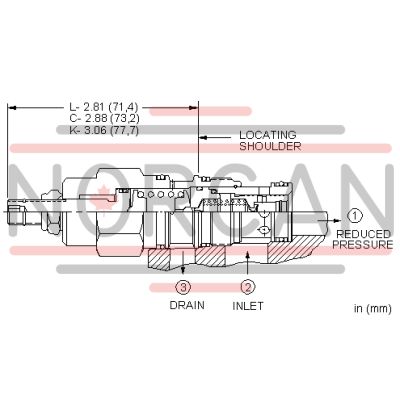
Pilot-operated, pressure reducing valves reduce a high primary pressure at the inlet (port 2) to a constant reduced pressure at port 1, allowing circuits with multiple pressure requirements to be operated using a single pump.
- All three-port pressure reducing and reducing/relieving cartridges are physically interchangeable (i.e. same flow path, same cavity for a given frame size). When considering mounting configurations, it is sometimes recommended that a full capacity return line (port 3) be used with reducing/relieving cartridges.
- Full reverse flow from reduced pressure (port 1) to inlet (port 2) may cause the main spool to close. If reverse free flow is required in the circuit, consider adding a separate check valve to the circuit.
- If pilot flow consumption is critical, consider using direct acting reducing/relieving valves.
- Main stage orifice is protected by a 150 micron stainless steel screen.
- Recommended maximum inlet pressure is determined by the adjustment range. Ranges D, E, N, and Q are tested with a 2000 psi (140 bar) maximum differential between inlet and reduced pressure. Ranges A, B, and H are tested with a 3000 psi (210 bar) maximum differential between inlet and reduced pressure. Ranges C and W are tested with 5000 psi (350 bar) of inlet pressure.
- Pilot operated valves exhibit exceptionally flat pressure/flow characteristics, are very stable and have low hysteresis.
- Pressure at port 3 is directly additive to the valve setting at a 1:1 ratio and should not exceed 5000 psi (350 bar).
- Pilot operated reducing, reducing/relieving valves by nature are not fast acting valves. For superior dynamic response, consider direct acting valves.
- W and Y controls (where applicable) can be specified with or without a special setting. When no special setting is specified, the valve is adjustable throughout its full range using the W or Y control. When a special setting is specified, this setting represents the maximum setting of the valve.
- Cartridges configured with EPDM seals are for use in systems with phosphate ester fluids. Exposure to petroleum based fluids, greases and lubricants will damage the seals.
- Incorporates the Sun floating style construction to minimize the possibility of internal parts binding due to excessive installation torque and/or cavity/cartridge machining variations.
| Cavity | T-2A |
| Series | 2 |
| Capacity | 20 gpm80 L/min. |
| Factory Pressure Settings Established at | blocked control port (dead headed)blocked control port (dead headed) |
| Maximum Operating Pressure | 5000 psi350 bar |
| Control Pilot Flow | 10 - 15 in³/min.0,16 - 0,25 L/min. |
| Adjustment - Number of Clockwise Turns to Increase Setting | 55 |
| Valve Hex Size | 1 1/8 in.28,6 mm |
| Valve Installation Torque | 45 - 50 lbf ft61 - 68 Nm |
| Adjustment Screw Internal Hex Size | 5/32 in.4 mm |
| Locknut Hex Size | 9/16 in.15 mm |
| Locknut Torque | 80 - 90 lbf in.9 - 10 Nm |
| Model Weight | .60 lb0,30 kg |
| Seal kit - Cartridge | Viton: 990-202-006 |
Show FAQ
Additional Resources
- QuickDesign with SmartConnect Offers Drag-and-Drop Schematic Tool
- Sun Expands Corrosion-Resistant Solutions
- Series 4 PLUS Cartridges Offer Higher Flows with Lower Pressure Losses
- Sun Offers Zinc-Nickel Plating for Corrosion Resistance
- Sun Cartridges with EPDM Seals
- Manufacturing Sun Cartridge Cavities
- Reducing and Reducing/Relieving Valves
- Cartridges: Materials of Construction
- Fluid and Temperature Recommendations
- Performance Data
- Sun's Floating Style Screw-In Cartridge
- Units of Measure, Settings, and Conversions
- Sun Model Code Explanation; 999-901-334
- Cavity Information (S-171) and Tooling
Notes:
- Maximum pressure differentials for spring ranges: A and B are 3000 psi (210 bar) N and Q are 2000 psi (140 bar) W is 5000 psi (350 bar)inlet pressure
- For Series 1 cartridges configured with an O control (panel mount handknob), a .75 in. (19 mm) diameter hole is required in the panel.