

SUN HYDRAULICS
RSJSCNV
$528.67 USD
- SUN HYDRAULICS
- Material:RSJSCNV
- Model:RSJS-CNV
- Summary:Cartridge
Quantity in stock: 0
***Disclaimer: The following summary contains information gathered from various sources such as product descriptions, technical specifications and catalogs. While efforts have been made to provide accurate details, inaccuracies may occur. It is advised to verify all information by contacting Sun Hydraulics directly.***
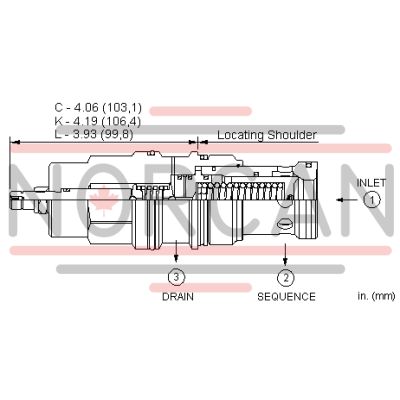
The Sun Hydraulics RSJSCNV (RSJSCNV) is a pilot-operated, balanced poppet sequence valve designed to supply a secondary circuit with flow once the pressure at inlet port 1 exceeds the valve setting. This valve regulates pressure at port 1 relative to the drain port 3 and is unaffected by back pressure at port 2 up to the valve setting, making it suitable for cross-port relief circuits. It features a 150-micron stainless steel screen protecting the main stage orifice and can handle maximum pressures of up to 5000 psi (350 bar). The valve's design includes Sun's floating style construction, minimizing internal part binding due to excessive installation torque or machining variations. With a capacity of 120 gpm (480 L/min), this cartridge is interchangeable within its series and frame size, sharing the same flow path and cavity. The control pilot flow ranges from 15 to 20 in\u00b3/min (0.25 to 0.33 L/min), with a typical response time of 2 ms. The maximum leakage at reseat is minimal, at only 10 drops/min (0.7 cc/min). The adjustment mechanism allows for increased settings with up to five clockwise turns, while installation requires specific torques for both the valve and locknut. This robust component weighs approximately 3.10 lb (1.40 kg) and utilizes Viton seals for optimal performance in hydraulic systems requiring precise pressure modulation without cavitation-related issues like noise or erosion.
The Sun Hydraulics RSJSCNV (RSJSCNV) is a pilot-operated, balanced poppet sequence valve designed to supply a secondary circuit with flow once the pressure at inlet port 1 exceeds the valve setting. This valve regulates pressure at port 1 relative to the drain port 3 and is unaffected by back pressure at port 2 up to the valve setting, making it suitable for cross-port relief circuits. It features a 150-micron stainless steel screen protecting the main stage orifice and can handle maximum pressures of up to 5000 psi (350 bar). The valve's design includes Sun's floating style construction, minimizing internal part binding due to excessive installation torque or machining variations. With a capacity of 120 gpm (480 L/min), this cartridge is interchangeable within its series and frame size, sharing the same flow path and cavity. The control pilot flow ranges from 15 to 20 in\u00b3/min (0.25 to 0.33 L/min), with a typical response time of 2 ms. The maximum leakage at reseat is minimal, at only 10 drops/min (0.7 cc/min). The adjustment mechanism allows for increased settings with up to five clockwise turns, while installation requires specific torques for both the valve and locknut. This robust component weighs approximately 3.10 lb (1.40 kg) and utilizes Viton seals for optimal performance in hydraulic systems requiring precise pressure modulation without cavitation-related issues like noise or erosion.
Pilot-operated, balanced poppet sequence valves will supply a secondary circuit with flow once the pressure at the inlet (port 1) has exceeded the valve setting. The pressure setting of a sequence valve controls the pressure at port 1 relative to the pressure at the drain (port 3). These valves are insensitive to back pressure at port 2 (sequence), up to the valve setting. They may be used to regulate pressure in place of 2-port relief valves if there is pressure in the return line.
- All 3 port sequence cartridges are physically and functionally interchangeable (i.e. same flow path, same cavity for a given frame size).
- Pilot flow continues to increase as the pressure at port 1 (inlet), relative to the pressure at port 3 (drain), rises above the valve setting.
- The main stage orifice is protected by a 150 micron stainless steel screen.
- Pressure at port 3 is directly additive to the valve setting at a 1:1 ratio and should not exceed 5000 psi (350 bar).
- Because the modulating occurs inside the cartridge these valves are immune to most of the problems associated with cavitation, namely noise and manifold erosion.
- Will accept maximum pressure at port 2; suitable for use in cross port relief circuits.
- Incorporates the Sun floating style construction to minimize the possibility of internal parts binding due to excessive installation torque and/or cavity/cartridge machining variations.
| Cavity | T-19A |
| Series | 4 |
| Capacity | 120 gpm480 L/min. |
| Factory Pressure Settings Established at | 4 gpm15 L/min. |
| Maximum Operating Pressure | 5000 psi350 bar |
| Control Pilot Flow | 15 - 20 in³/min.0,25 - 0,33 L/min. |
| Response Time - Typical | 2 ms2 ms |
| Maximum Valve Leakage at Reseat | 10 drops/min.0,7 cc/min. |
| Adjustment - Number of Clockwise Turns to Increase Setting | 55 |
| Valve Hex Size | 1 5/8 in.41,3 mm |
| Valve Installation Torque | 350 - 375 lbf ft474 - 508 Nm |
| Adjustment Screw Internal Hex Size | 5/32 in.4 mm |
| Locknut Hex Size | 9/16 in.15 mm |
| Locknut Torque | 80 - 90 lbf in.9 - 10 Nm |
| Model Weight | 3.10 lb1,40 kg |
| Seal kit - Cartridge | Viton: 990-219-006 |
Show FAQ
Additional Resources
- Sun Offers Zinc-Nickel Plating for Corrosion Resistance
- Sun Cartridges with EPDM Seals
- Sun Expands Corrosion-Resistant Solutions
- QuickDesign with SmartConnect Offers Drag-and-Drop Schematic Tool
- Series 4 PLUS Cartridges Offer Higher Flows with Lower Pressure Losses
- Sequence Valves Technical Tips
- Manufacturing Sun Cartridge Cavities
- Sequence Valves
- Sun Model Code Explanation; 999-901-334
- Cavity Information (S-171) and Tooling
- Cartridges: Materials of Construction
- Fluid and Temperature Recommendations
- Performance Data
- Sun's Floating Style Screw-In Cartridge
- Units of Measure, Settings, and Conversions