

SUN HYDRAULICS
RVEBNDN
$148.82 USD
- SUN HYDRAULICS
- Material:RVEBNDN
- Model:RVEB-NDN
- Summary:Cartridge
Quantity in stock: 0
***Disclaimer: The following summary contains information gathered from various sources such as product descriptions, technical specifications and catalogs. While efforts have been made to provide accurate details, inaccuracies may occur. It is advised to verify all information by contacting Sun Hydraulics directly.***
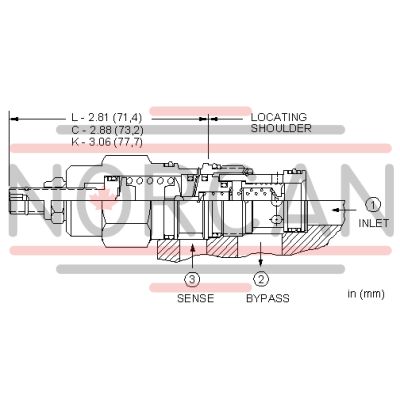
The Sun Hydraulics RVEBNDN (RVEBNDN) is a versatile three-port normally closed modulating element with relief capabilities, designed to provide dual functions when used alongside an external orifice. This component acts as a bypass compensator, effectively managing priority flow into a circuit while directing excess input flow to the tank port 2. It also functions as a standard relief valve if the inlet pressure at port 1 exceeds the pre-set threshold. The compensating pressure for all ranges is set at 120 psi (8 bar). The valve's performance is illustrated by its capacity to maintain a consistent pressure differential across the control orifice, irrespective of control flow, and is instead determined by bypass flow. The RVEBNDN supports an operating capacity of 20 gpm (80 L/min) with factory pressure settings established at 4 gpm (15 L/min). It can withstand a maximum operating pressure of up to 5000 psi (350 bar), ensuring robust performance in demanding applications. The valve features adjustable settings throughout its full range via W and Y controls, with special settings available for maximum adjustment limits if specified. It responds swiftly with a typical response time of just 10 ms and maintains minimal leakage under standard conditions. Installation parameters include a valve hex size of 1-1/8 in. (28.6 mm) and installation torque ranging from 45 to 50 lbf ft (61 to 68 Nm). For adjustments, it requires up to five clockwise turns, with an internal hex size for the adjustment screw at 5/32 in. (4 mm). The locknut hex size measures at 9/16 in. (15 mm), secured with torque between 80 to 90 lbf in. (9 to 10 Nm). Additionally, it comes equipped with Viton seals for enhanced durability and weighs approximately .70 lb (.30 kg).
The Sun Hydraulics RVEBNDN (RVEBNDN) is a versatile three-port normally closed modulating element with relief capabilities, designed to provide dual functions when used alongside an external orifice. This component acts as a bypass compensator, effectively managing priority flow into a circuit while directing excess input flow to the tank port 2. It also functions as a standard relief valve if the inlet pressure at port 1 exceeds the pre-set threshold. The compensating pressure for all ranges is set at 120 psi (8 bar). The valve's performance is illustrated by its capacity to maintain a consistent pressure differential across the control orifice, irrespective of control flow, and is instead determined by bypass flow. The RVEBNDN supports an operating capacity of 20 gpm (80 L/min) with factory pressure settings established at 4 gpm (15 L/min). It can withstand a maximum operating pressure of up to 5000 psi (350 bar), ensuring robust performance in demanding applications. The valve features adjustable settings throughout its full range via W and Y controls, with special settings available for maximum adjustment limits if specified. It responds swiftly with a typical response time of just 10 ms and maintains minimal leakage under standard conditions. Installation parameters include a valve hex size of 1-1/8 in. (28.6 mm) and installation torque ranging from 45 to 50 lbf ft (61 to 68 Nm). For adjustments, it requires up to five clockwise turns, with an internal hex size for the adjustment screw at 5/32 in. (4 mm). The locknut hex size measures at 9/16 in. (15 mm), secured with torque between 80 to 90 lbf in. (9 to 10 Nm). Additionally, it comes equipped with Viton seals for enhanced durability and weighs approximately .70 lb (.30 kg).
Three-port normally closed modulating elements with relief provide two functions when combined with an external orifice. The mainstage is a bypass compensator that controls a priority flow into the circuit, determined by the external orifice. Input flow in excess of the priority flow is bypassed to tank (port 2). If the inlet (port 1) pressure rises to the valve setting, the valve operates as a normal relief valve.
- Compensating pressure for all ranges is 120 psi (8 bar).
- Explanation of the performance curve: The X axis is system pressure. The Y axis shows the pressure differential that the valve creates across the control orifice. The curves represent various bypass flows (pump flow minus control flow). The capacity and performance of this valve is determined by the bypass flow, control flow is not a factor.
- W and Y controls (where applicable) can be specified with or without a special setting. When no special setting is specified, the valve is adjustable throughout its full range using the W or Y control. When a special setting is specified, this setting represents the maximum setting of the valve.
| Cavity | T-2A |
| Series | 2 |
| Capacity | 20 gpm80 L/min. |
| Factory Pressure Settings Established at | 4 gpm15 L/min. |
| Maximum Operating Pressure | 5000 psi350 bar |
| Response Time - Typical | 10 ms10 ms |
| Maximum Valve Leakage at 110 SUS (24 cSt) | 3 in³/min.@1000 psi50 cc/min.@70 bar |
| Adjustment - Number of Clockwise Turns to Increase Setting | 55 |
| Valve Hex Size | 1 1/8 in.28,6 mm |
| Valve Installation Torque | 45 - 50 lbf ft61 - 68 Nm |
| Adjustment Screw Internal Hex Size | 5/32 in.4 mm |
| Locknut Hex Size | 9/16 in.15 mm |
| Locknut Torque | 80 - 90 lbf in.9 - 10 Nm |
| Model Weight | .70 lb0,30 kg |
| Seal kit - Cartridge | Viton: 990-202-006 |
Show FAQ
Additional Resources
- Sun Cartridges with EPDM Seals
- QuickDesign with SmartConnect Offers Drag-and-Drop Schematic Tool
- Sun Expands Corrosion-Resistant Solutions
- Series 4 PLUS Cartridges Offer Higher Flows with Lower Pressure Losses
- Sun Offers Zinc-Nickel Plating for Corrosion Resistance
- Manufacturing Sun Cartridge Cavities
- Cartridges: Materials of Construction
- Cavity Information (S-171) and Tooling
- Fluid and Temperature Recommendations
- Sun's Floating Style Screw-In Cartridge
- Performance Data
- Sun Model Code Explanation; 999-901-334
- Units of Measure, Settings, and Conversions