

SUN HYDRAULICS
RVIBCBN
$598.96 USD
- SUN HYDRAULICS
- Material:RVIBCBN
- Model:RVIB-CBN
- Summary:Cartridge
Quantity in stock: 0
***Disclaimer: The following summary contains information gathered from various sources such as product descriptions, technical specifications and catalogs. While efforts have been made to provide accurate details, inaccuracies may occur. It is advised to verify all information by contacting Sun Hydraulics directly.***
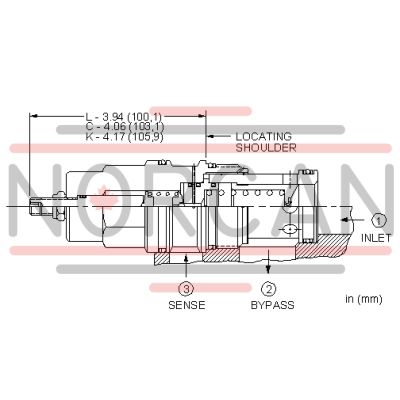
The Sun Hydraulics RVIBCBN (RVIBCBN) is a three-port normally closed modulating element with relief capabilities, designed to provide dual functions when paired with an external orifice. This component acts as a bypass compensator, controlling priority flow into the circuit based on the external orifice's specifications. Any input flow exceeding the priority flow is redirected to tank port 2. Additionally, if the pressure at inlet port 1 exceeds the valve's setting, it operates as a standard relief valve. The compensating pressure for all ranges is set at 90 psi (6 bar). The performance curve illustrates that while system pressure is indicated on the X-axis, the Y-axis demonstrates the pressure differential created across the control orifice by this valve. Various curves represent different bypass flows, which are calculated by subtracting control flow from pump flow; thus, bypass flow determines capacity and performance rather than control flow. This model is equipped with EPDM seals suitable for systems using phosphate ester fluids; however, these seals are susceptible to damage from petroleum-based fluids, greases, and lubricants. The RVIBCBN fits into cavity T-19A and belongs to Series 4 with a capacity of 80 gpm (320 L/min). It can handle a maximum operating pressure of 5000 psi (350 bar) and typically responds within 10 milliseconds. Maximum valve leakage at 110 SUS (24 cSt) is rated at 5 in\u00b3/min (80 cc/min) under conditions of 1000 psi (70 bar). Adjustment settings are made through clockwise turns up to 5.5 times to increase settings. Installation requires a torque between 350 - 375 lbf ft (474 - 508 Nm), with additional specifications provided for various screw sizes and locknut torque requirements. The model weighs approximately 3.10 lb (1.40 kg), and Viton seal kits are available under part number 990019006.
The Sun Hydraulics RVIBCBN (RVIBCBN) is a three-port normally closed modulating element with relief capabilities, designed to provide dual functions when paired with an external orifice. This component acts as a bypass compensator, controlling priority flow into the circuit based on the external orifice's specifications. Any input flow exceeding the priority flow is redirected to tank port 2. Additionally, if the pressure at inlet port 1 exceeds the valve's setting, it operates as a standard relief valve. The compensating pressure for all ranges is set at 90 psi (6 bar). The performance curve illustrates that while system pressure is indicated on the X-axis, the Y-axis demonstrates the pressure differential created across the control orifice by this valve. Various curves represent different bypass flows, which are calculated by subtracting control flow from pump flow; thus, bypass flow determines capacity and performance rather than control flow. This model is equipped with EPDM seals suitable for systems using phosphate ester fluids; however, these seals are susceptible to damage from petroleum-based fluids, greases, and lubricants. The RVIBCBN fits into cavity T-19A and belongs to Series 4 with a capacity of 80 gpm (320 L/min). It can handle a maximum operating pressure of 5000 psi (350 bar) and typically responds within 10 milliseconds. Maximum valve leakage at 110 SUS (24 cSt) is rated at 5 in\u00b3/min (80 cc/min) under conditions of 1000 psi (70 bar). Adjustment settings are made through clockwise turns up to 5.5 times to increase settings. Installation requires a torque between 350 - 375 lbf ft (474 - 508 Nm), with additional specifications provided for various screw sizes and locknut torque requirements. The model weighs approximately 3.10 lb (1.40 kg), and Viton seal kits are available under part number 990019006.
Three-port normally closed modulating elements with relief provide two functions when combined with an external orifice. The mainstage is a bypass compensator that controls a priority flow into the circuit, determined by the external orifice. Input flow in excess of the priority flow is bypassed to tank (port 2). If the inlet (port 1) pressure rises to the valve setting, the valve operates as a normal relief valve.
- Compensating pressure for all ranges is 90 psi (6 bar).
- Explanation of the performance curve: The X axis is system pressure. The Y axis shows the pressure differential that the valve creates across the control orifice. The curves represent various bypass flows (pump flow minus control flow). The capacity and performance of this valve is determined by the bypass flow, control flow is not a factor.
- Cartridges configured with EPDM seals are for use in systems with phosphate ester fluids. Exposure to petroleum based fluids, greases and lubricants will damage the seals.
| Cavity | T-19A |
| Series | 4 |
| Capacity | 80 gpm320 L/min. |
| Factory Pressure Settings Established at | 4 gpm15 L/min. |
| Maximum Operating Pressure | 5000 psi350 bar |
| Response Time - Typical | 10 ms10 ms |
| Maximum Valve Leakage at 110 SUS (24 cSt) | 5 in³/min.@1000 psi80 cc/min.@70 bar |
| Adjustment - Number of Clockwise Turns to Increase Setting | 55 |
| Valve Hex Size | 1 5/8 in.41,3 mm |
| Valve Installation Torque | 350 - 375 lbf ft474 - 508 Nm |
| Adjustment Screw Internal Hex Size | 5/32 in.4 mm |
| Locknut Hex Size | 9/16 in.15 mm |
| Locknut Torque | 80 - 90 lbf in.9 - 10 Nm |
| Model Weight | 3.10 lb1,40 kg |
| Seal kit - Cartridge | Viton: 990-019-006 |
Show FAQ
Additional Resources
- Sun Cartridges with EPDM Seals
- QuickDesign with SmartConnect Offers Drag-and-Drop Schematic Tool
- Sun Expands Corrosion-Resistant Solutions
- Series 4 PLUS Cartridges Offer Higher Flows with Lower Pressure Losses
- Sun Offers Zinc-Nickel Plating for Corrosion Resistance
- Manufacturing Sun Cartridge Cavities
- Cartridges: Materials of Construction
- Cavity Information (S-171) and Tooling
- Fluid and Temperature Recommendations
- Sun's Floating Style Screw-In Cartridge
- Performance Data
- Sun Model Code Explanation; 999-901-334
- Units of Measure, Settings, and Conversions