

SUN HYDRAULICS
SQJBKCV
$570.76 USD
- SUN HYDRAULICS
- Material:SQJBKCV
- Model:SQJB-KCV
- Summary:Cartridge
Quantity in stock: 0
***Disclaimer: The following summary contains information gathered from various sources such as product descriptions, technical specifications and catalogs. While efforts have been made to provide accurate details, inaccuracies may occur. It is advised to verify all information by contacting Sun Hydraulics directly.***
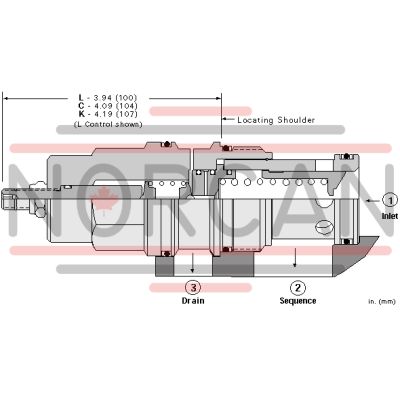
The Sun Hydraulics SQJBKCV (SQJBKCV) is a sophisticated kickdown sequence valve designed to manage flow in hydraulic systems by kicking open and maintaining an open state once the inlet port 1 pressure surpasses the valve setting. This creates an unrestricted flow path from port 1 to port 2. The valve remains open as long as the inlet pressure exceeds that of port 2, requiring a reset by reducing port 1 pressure below its setting, stopping flow from port 1 to port 2, and ensuring equal or greater pressure at port 2 compared to port 1. Notably, this valve should not be used in load-holding applications. It features a main stage orifice protected by a 150-micron stainless steel screen and can handle pressures up to 5000 psi (350 bar) at port 3, which adds directly to the valve setting at a 1:1 ratio. Designed for use on the actuator side of systems, it incorporates Sun's floating style construction to minimize internal part binding due to installation torque or machining variations. The SQJBKCV has a capacity of up to 120 gpm (480 L/min), with factory pressure settings established at the kickdown point and a typical response time of approximately 25 ms. The maximum operating pressure is rated at 5000 psi (350 bar), with minimal leakage under specified conditions. Installation requires specific torques for both the valve body and locknut, ensuring secure placement within hydraulic systems. Additionally, it comes with a Viton seal kit for enhanced durability and compatibility with various hydraulic fluids.
The Sun Hydraulics SQJBKCV (SQJBKCV) is a sophisticated kickdown sequence valve designed to manage flow in hydraulic systems by kicking open and maintaining an open state once the inlet port 1 pressure surpasses the valve setting. This creates an unrestricted flow path from port 1 to port 2. The valve remains open as long as the inlet pressure exceeds that of port 2, requiring a reset by reducing port 1 pressure below its setting, stopping flow from port 1 to port 2, and ensuring equal or greater pressure at port 2 compared to port 1. Notably, this valve should not be used in load-holding applications. It features a main stage orifice protected by a 150-micron stainless steel screen and can handle pressures up to 5000 psi (350 bar) at port 3, which adds directly to the valve setting at a 1:1 ratio. Designed for use on the actuator side of systems, it incorporates Sun's floating style construction to minimize internal part binding due to installation torque or machining variations. The SQJBKCV has a capacity of up to 120 gpm (480 L/min), with factory pressure settings established at the kickdown point and a typical response time of approximately 25 ms. The maximum operating pressure is rated at 5000 psi (350 bar), with minimal leakage under specified conditions. Installation requires specific torques for both the valve body and locknut, ensuring secure placement within hydraulic systems. Additionally, it comes with a Viton seal kit for enhanced durability and compatibility with various hydraulic fluids.
Kick-down sequence valves will kick completely open and remain open once the pressure at the inlet (port 1) exceeds the valve setting, creating an unrestricted flow path from port 1 to port 2 (sequence). The pressure setting at port 1 is relative to the drain (port 3). The valve remains open as long as the pressure at port 1 exceeds the pressure at port 2. To reset the valve, pressure at port 1 must fall below the setting of the valve, flow from port 1 to port 2 must cease, and pressure at port 2 must be equal to or greater than the pressure at port 1.
- All 3 port sequence cartridges are physically and functionally interchangeable (i.e. same flow path, same cavity for a given frame size).
- Should not be used in load holding applications.
- The main stage orifice is protected by a 150 micron stainless steel screen.
- Pressure at port 3 is directly additive to the valve setting at a 1:1 ratio and should not exceed 5000 psi (350 bar).
- Intended for use on the actuator side of the system as flow through the valve must cease for the valve to reset. If used on the pump side of a system, pump flow must be shut off for the valve to reset.
- Incorporates the Sun floating style construction to minimize the possibility of internal parts binding due to excessive installation torque and/or cavity/cartridge machining variations.
| Cavity | T-19A |
| Series | 4 |
| Capacity | 120 gpm480 L/min. |
| Factory Pressure Settings Established at | Kick down pointKick down point |
| Maximum Operating Pressure | 5000 psi350 bar |
| Response Time - Typical | 25 ms25 ms |
| Maximum Valve Leakage at 110 SUS (24 cSt) | 5 in³/min.80 cc/min. |
| Adjustment - Number of Clockwise Turns to Increase Setting | 55 |
| Valve Hex Size | 1 5/8 in.41,3 mm |
| Valve Installation Torque | 350 - 375 lbf ft474 - 508 Nm |
| Adjustment Screw Internal Hex Size | 5/32 in.4 mm |
| Locknut Hex Size | 9/16 in.15 mm |
| Locknut Torque | 80 - 90 lbf in.9 - 10 Nm |
| Model Weight | 3.10 lb1,40 kg |
| Seal kit - Cartridge | Viton: 990-019-006 |
Show FAQ
Additional Resources
- Sun Offers Zinc-Nickel Plating for Corrosion Resistance
- Sun Cartridges with EPDM Seals
- Sun Expands Corrosion-Resistant Solutions
- QuickDesign with SmartConnect Offers Drag-and-Drop Schematic Tool
- Series 4 PLUS Cartridges Offer Higher Flows with Lower Pressure Losses
- Sequence Valves Technical Tips
- Manufacturing Sun Cartridge Cavities
- Sequence Valves
- Sun Model Code Explanation; 999-901-334
- Cavity Information (S-171) and Tooling
- Cartridges: Materials of Construction
- Fluid and Temperature Recommendations
- Performance Data
- Sun's Floating Style Screw-In Cartridge
- Units of Measure, Settings, and Conversions